For the past two months on Sundays, I have been attending the Boulder Friend’s Quaker Meeting worship gathering. If you’re unfamiliar with Quaker worship, basically, there are no set preachers or sermons and silent worship takes up the majority of the time. Occasionally, a member of the Congregation will stand and speak if they feel sufficiently “compelled” to do so. Quakerism is sort of a mystical tradition. They believe all of us have the potential to access the divine—we don’t need a sacred text or a religious guide to help us understand the Truth.
In my very early days attending Quaker worship, I found the easiest way for me to understand what we’re doing is by thinking of it as a sort of listening practice. We work to learn how to listen for our truths, the world’s truth, and the truth of others. Moreover, we work to learn how to listen bravely, compassionately, and lovingly. I have no idea what the divine sounds like, or whether the truthing tones that tickle my ears are the right pitch, but the act of intentionally listening for an hour in worship is an important part of my week as it often primes my ears, eyes, and heart with a certain direction for the week to come.
A few Sundays ago, the listening was rather emotional. It was Father’s Day and several people shared griefs and sorrows in regards to childhood wounds and relationships with their fathers. Some people sang songs. Others, such as myself, merely sat and listened during the first part of worship.
What was I listening for? I didn’t know when I entered the building, but not more than a few minutes into worship passed before I started to sense my father’s presence.
Oh, goodness. Do I sit with this? Or do I psychically run away, directing my consciousness to a far safer place?
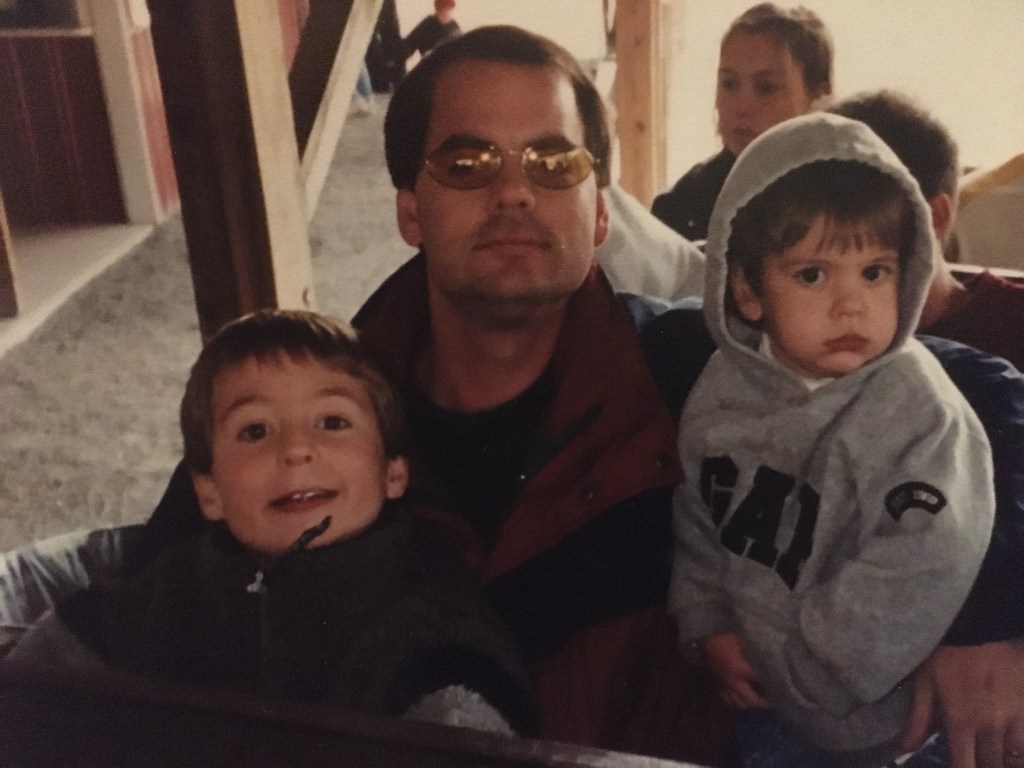
The cruelty of this dark and dreary world killed him five days after I turned six. Even though his finger pulled the trigger, I try to distribute responsibility across all of the dark transgressions one is subjected to through the course of a life. His death has been hard on me. But I’m doing really well now almost 20 years later. Years of therapy, self-exploration, introspecting, talking, and listening to others tell tales of who he was has given me some sort of picture of him and his life.
My father is a painting, made up of colors and brush strokes. An impressionist painting with jagged lines but smoothness around his eyes. I don’t really spend much time with the brush in my hand, but there is that rare occasion where I become adamant about some detail or other. But something I almost never do is hand my father, Jason, the paintbrush.
He’s dead, right? Why should he participate in the painting of his portrait, or of the writing of my present?
So there I was in worship, listening to—I don’t really know what exactly—but listening nonetheless. And I hear the door of the room open. The soft cadence of a gentle footfall: my father walks into the room.
I sense his presence. And I’m so scared. Underneath closed eyelids, I feel my eyes flicker. I want to open them to erase his presence, to shatter whatever illusion I was living in by confirming that he wasn’t actually standing there.
But I didn’t open them. I just kept them closed, saw him in my mind’s eye, and tried to listen.
I imagined all sorts of things. The “I’m proud of you”s and the “you did nothing wrong”s, the “I love you, son”s and the “I really haven’t left you”s. But I had started reaching for something, manifesting my own desires into whatever sacred presence was before me. So, I tried to stop my mind’s active imagining and focus, yet again, on just listening. Perhaps what he was saying was sublingual, and I needed to interpret it another way, setting aside my thinking mind.
A chill came over me and my eyes started to well up, but they didn’t spill over. Why are you here? Why are you here now? Have you been here the whole time? Have I been the one rejecting and abandoning you each day as I’ve journeyed on through my life?
“Okay, Dad,” I thought, “this Father’s Day, I’ll hang out with you.”
During the personal joys and sorrows portion of worship, I stood to speak to the congregation. My voice was shaking with strength. “My name is Matt. When I was a little boy, my father took his life. His name is Jason Nesselrodt. Please hold him and his memory in the light.”
The congregation let out a few sympathetic exhalations. I sat down with love for my father, an active and painful love that tried to situate our relationship in the present moment rather than in the past. How about we have a relationship now, Dad? One that can be defined by something more than the trigger.
After the Quaker meeting, I decided to go play basketball in the park and to invite him to come play with me. Since the time I could walk, I remember playing basketball with him. After he died, it was a way I could feel connected to him. Growing up, I put my whole heart into it. But I didn’t have the confidence to succeed. In a dramatic fashion—dramatic to me at least—I quit my junior year of high school after two years on varsity.
I’ve always had a complicated relationship with the game. It is impossible to disentangle my relationship with basketball and my father; they are so deeply enmeshed. So, inviting his spirit to come play with me at the park on Father’s Day was a scary attempt to make some amends, amends to the game and amends with him.
But I was scared. If he didn’t show up, would I not just feel completely rejected yet again? Ah well. In the spirit of listening, I decided I would go and try anyway.
Playing with a recently injured knee, I could barely do anything more than shoot the ball and slowly hobble to get it on a miss. My broken knee seemed to signify my maturation into adulthood. Through this injury sustained through the very dangerous activity of a light butterfly stretch, I had to acknowledge I was no longer a little boy throwing the ball at a hoop as if it would fulfill all of my dreams of a happy life, and a father who loves me even beyond the grave.
Or did I? Maybe this could be the start of a brand new relationship with my father. Maybe I could learn to love him and the game anew.
I decided to head to the free throw line. After a few warm ups, I told myself to make 10 in a row. It was a bit of a test. If I made 10 in a row, then he was likely there with me in spirit. After the first three makes, I started to get nervous. 3 more went in and I started to have hope. Now, each shot had a lot of pressure. 7. 8. 9. All of them went in and the pressure continued to mount.
Before the tenth shot, I said, “Okay, Dad. If you’re here with me, help me make this shot.”
I did my routine that I’d done for years, the routine I remember him showing me when I was five years old. Three simple dribbles, catching the ball for a second with both hands, flicking it down to the ground with the right wrist in a way that mirrors my shooting form. I lift the ball up into position, make eye contact with the rim, and, anxiously, shoot the shot, holding my follow-through alongside a crooked hope for my father’s love.
It clinked off the rim. A miss.
Well, fuck.
So much for that.
Thanks, Dad.
In that moment, I felt sadness and disappointment, but mostly I felt anger. He’d rejected me yet again.
I decided to keep shooting around on my own, no longer caring if he was joining me or not. I’d make ten consecutive mid range shots to feel better about myself. Whether he was there with me or not didn’t matter. I just wanted to not feel like a failure, to feel like I could do it on my own regardless of if he came out to play with me.
After making ten shots, I figured it was high time to get off my knee and stop hobbling around. I’m too old for this shit, I thought. I chuckled.
When leaving the concrete, I glanced back at the court, looking for one last sign of him. Nothing. I turned back around and started walking to my car.
I walked by him and then stopped in my tracks.
A man sat on a blanket under a tree, facing the direction of the court, as if he had been watching. He looked like he was in his mid 30s, the age my dad was when he died. A tight white muscle tee shirt showed his arms. He wore a blue bandana over his bald head.
This was about as close of a physical manifestation of my memory of him that I could have imagined. A blue bandana is the only piece of clothing that I own that was his. A shudder ran through my body and my heart started pounding. Is this what normal Boulderites look like? I wondered. No, not typically, I decided.
Thinking as quickly as I could, I weighed my options. Should I go ask him if his name was Jason? Should I go ask him if he’d like to shoot basketball with me? Or should I keep walking to my car, denying this strange man who may or may not be a physical manifestation of my father’s spirit the opportunity to reject me yet again.
In all but a second, I made up my mind. I walked to my car, opened the door, hesitated for a final moment, looked back at the man, got in my car, sat down, and drove away.
I decided that it wasn’t a total rejection of any sort of future relationship with my father and his spirit. In a way, I was accepting him while still protecting myself. I wanted the ambiguity of the moment to persist in my memory, rather than ossify any sort of Truth about this apparition.
The embodied ghost will forever remain mysterious in my memory, in that third space between dream and reality, truth and imagination, forgiveness and unforgiveness.
 Thinking Thoughts
Leave a comment